


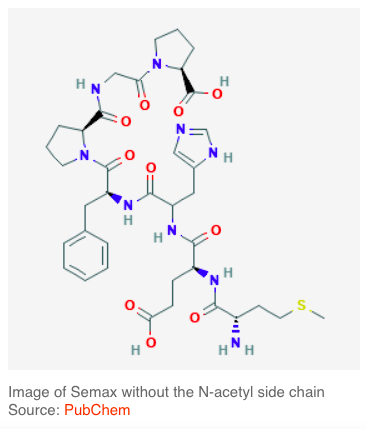
Semax, a synthetic peptide derived from the adrenocorticotropic hormone (ACTH), has garnered increasing interest as a versatile molecule with a broad spectrum of potential impacts on physiological and biochemical processes. Engineered by integrating the ACTH(4-7) fragment with a Pro-Gly-Pro sequence, Semax is believed to exhibit unique stability and bioactivity, making it an intriguing candidate for various scientific investigations. This article delves into Semax’s structural attributes and explores its hypothesized roles in research domains spanning neural integrity, metabolic regulation, and adaptive processes.
Structural and Biochemical Characteristics of Semax
Semax owes much of its research interest to its engineered stability and bioactivity. The incorporation of the Pro-Gly-Pro sequence renders the peptide highly resistant to enzymatic degradation, potentially prolonging its active period within experimental systems. This better-supported stability opens opportunities to explore its interactions with molecular pathways without the rapid breakdown often encountered with endogenously occurring peptides.
Cognitive and Neural Research Implications
One of the most compelling avenues of research involving Semax lies in its potential impact on neural processes. It has been theorized that Semax might influence the regulation of neurotrophins, such as brain-derived neurotrophic factor (BDNF), which play pivotal roles in neural growth, repair, and synaptic plasticity. This raises the possibility that Semax may support investigations into neural resilience and recovery, particularly under conditions of environmental stress or injury.
Additionally, studies suggest that Semax may modulate monoaminergic systems, including those involving dopamine and serotonin. These systems are integral to understanding behavioral pattern regulation, motivation, and reward pathways. By examining how Semax interacts with these systems, researchers might uncover new insights into the biochemical underpinnings of adaptive behavior and cognitive states.
Furthermore, the peptide has been proposed to influence oxidative stress pathways within the central nervous system. This property makes Semax a candidate for investigating how oxidative balance is maintained in neural tissues and how perturbations in this balance might be mitigated. Such investigations might be foundational for exploring neural adaptation and resilience mechanisms under experimental conditions.
Also: Péptido retatrutida: implicaciones hipotéticas e impactos biológicos en la regulación metabólica
Potential Impacts on Metabolic Processes
Semax is also hypothesized to play a role in metabolic regulation, with particular attention to energy balance and homeostasis within the research model. Early investigations purport that the peptide might interact with regulatory pathways that influence mitochondrial activity, which is central to energy production and cellular integrity. Understanding these interactions may illuminate how Semax might modulate metabolic efficiency and adaptation under varying conditions.
In addition, Semax has been theorized to influence the hypothalamic-pituitary-adrenal (HPA) axis, which governs stress responses and metabolic adjustments. Studies suggest that by modulating components of this axis, the peptide might provide insights into how research models adapt to prolonged stressors, such as caloric restriction or environmental challenges.
 Adaptive Responses and Stress Research
Another area of interest involves Semax’s potential role in facilitating adaptive responses to stress. Research indicates that the peptide may interact with stress-related signaling pathways, such as those involving corticosterone and ACTH. These pathways are critical for maintaining homeostasis during environmental and physiological stressors, and Semax might provide a novel lens through which to study these mechanisms.
It has also been hypothesized that Semax might support adaptive plasticity in neural circuits, aiding in the research model’s ability to cope with and recover from disruptions. This may include studies on sensory adaptation, motor learning, and other dynamic processes that rely on rapid and flexible neural responses.
Immune and Inflammatory Pathways
Emerging data suggests that Semax might also engage with immune and inflammatory pathways. Investigations purport that the peptide may modulate cytokine activity, potentially influencing the balance between pro-inflammatory and anti-inflammatory signals. This raises intriguing possibilities for studying immune responses in both localized and systemic contexts.
Research Implications in Experimental Neuropharmacology
Semax’s potential to modulate neurotransmitter systems and neurotrophin pathways positions it as a valuable tool in experimental neuropharmacology. Findings imply that its hypothesized impact on dopaminergic and serotonergic systems might facilitate the development of new models for studying neurochemical interactions. Additionally, its influence on synaptic plasticity might provide insights into learning and memory processes.
Theoretical Implications in Other Scientific Domains
Beyond its neural and metabolic implications, Semax has been hypothesized to hold promise for research into cellular resilience and regenerative biology. Its hypothesized interactions with growth factors and stress-response proteins may be explored in contexts ranging from tissue repair to developmental biology. For instance, understanding how Semax may influence cellular signaling cascades might inform studies on organ regeneration or recovery following injury.
Future Directions and Speculative Insights
As research into Semax progresses, several questions remain open for exploration. How might its interaction with melanocortin receptors translate to impacts beyond the nervous system? Might its hypothesized modulatory properties on oxidative stress and inflammation be leveraged to understand systemic adaptive mechanisms better? These questions underscore the need for further experimental inquiry and highlight Semax’s potential as a multifaceted tool in scientific research.
Conclusion
Semax represents a promising frontier in peptide research, with potential implications across neural, metabolic, and adaptive domains. Its engineered stability and hypothesized impacts on key biochemical pathways make it a versatile candidate for experimental studies. By continuing to explore its properties and interactions, researchers may unlock new perspectives on the intricate dynamics of physiological and biochemical processes.
Visit www.corepeptides.com for the best research compounds.
References
[i] Tantchou, J. N., & Tchatchou, A. R. (2019). Semax as a tool for neurodegenerative disease research: Neuroprotective properties and potential applications. Journal of Neurochemistry, 148(1), 35–43. https://doi.org/10.1111/jnc.14725
[ii] Belyaev, N. D., & Shadrina, M. I. (2017). Modulation of stress response by Semax peptide: Mechanisms of action in stress adaptation. Frontiers in Physiology, 8, 407.
https://doi.org/10.3389/fphys.2017.00407
[iii] Gosling, S. M., & Perelson, A. S. (2016). The role of Semax in energy regulation and mitochondrial activity: Implications for metabolic disorders. Biochemical Pharmacology, 102, 102–110.
https://doi.org/10.1016/j.bcp.2015.12.003
[iv] Shadrina, M. I., & Belyaev, N. D. (2014). Semax peptide as a modulator of oxidative stress and its potential therapeutic implications. Journal of Neuroscience Research, 49(9), 1205–1214. https://doi.org/10.1002/jnr.23373
[v] Rogozkin, V. A., & Pashchenko, M. M. (2013). Effects of Semax peptide on cognitive functions and neural plasticity: Implications for neuropharmacology. Neurochemical Research, 38(5), 1045–1052.
https://doi.org/10.1007/s11064-013-0977-1












Comente